One platform for cleaning, security and maintenance teams: running a mobile FM workforce
Reading time 3 min.
An FM provider with cleaning, security and maintenance contracts often runs three businesses side by side. Each service has its own rota tool, its own paperwork and its own way of reporting to the client. Head office then stitches it all together for payroll, invoicing and the monthly review.
This guide looks at what changes when every service line works from one mobile platform, and where to start.
The cost of running three systems
Separate systems for each service create the same problems in three places:
- Staff details, rotas and hours are kept separately, then retyped for payroll.
- A client with several services gets several reports in different formats.
- Supervisors covering more than one service learn more than one tool.
- Nobody can see the whole contract's performance in one view.
Integrated FM contracts make this worse, because the client expects one provider and one picture.
What changes on one platform
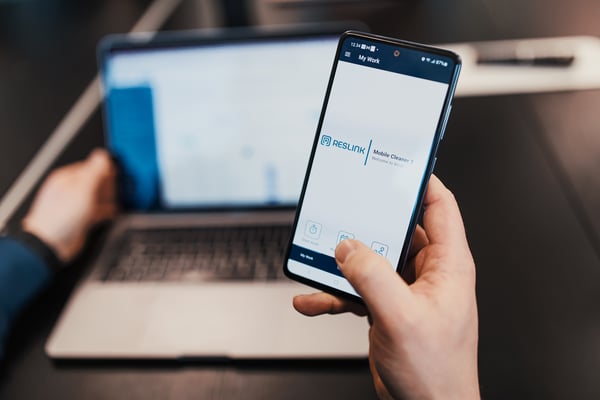
One app for every frontline worker. Cleaners, officers and engineers each see their own shifts, sites and tasks, set up for their role. A cleaner sees task lists; an officer sees rounds and checkpoints; an engineer sees work orders and assets.
One record of time. Clock-in at the site feeds one set of timesheets and one payroll export, whatever the service.
One view per site and per client. Managers see what is done, late or open across every service on a site. Clients get one report that covers the whole contract.
One place to change things. Forms and checklists can be changed for a site or a service without a development project.
People: onboarding, TUPE and right to work
FM workforces change constantly. Contracts are won and lost, and staff often move between employers under the TUPE regulations. Each new starter also needs right to work checks and site inductions before their first shift.
Doing this on paper slows down every mobilisation. On one platform, new or transferring staff can complete forms on their phone, records are stored against the person, and supervisors can see who is ready to be rostered.
In Reslink, new starters get a training plan from day one, and each worker's contract details, training history and equipment sit on one Employee Card.
Communicating with a dispersed team
Frontline FM staff rarely sit at a desk or read company email. Push messages to their phone reach them where they work, whether it's a site-wide update, a change to one shift or a reminder before an audit.
Where to start
Moving every service at once is rarely wise. Most providers start with the service that has the most paperwork or the most client pressure, prove the approach on a few sites, then add the next service. A platform that is quick to set up makes that phased approach realistic.
How Reslink supports integrated FM
Reslink is one mobile platform for cleaning, security, maintenance and real estate operators. It covers workflow management, rounds and patrols, digital forms, asset management, time and attendance, employee lifecycle management and push messaging, and connects to HR, payroll and ERP systems.
More than 55,000 people in over 10 countries use Reslink, submitting around 25 million forms a year. Customer retention is 99%, and most customers are live in under eight weeks.
Questions buyers ask
What is integrated facilities management?
A contract where one provider delivers several services, such as cleaning, security and maintenance, under one agreement.
Can one app work for cleaners, officers and engineers?
Yes, if each role sees only what it needs. In Reslink, cleaners see task lists, officers see rounds and checkpoints, and engineers see work orders.
What is TUPE?
The Transfer of Undertakings (Protection of Employment) Regulations protect employees' terms when a contract or business moves to a new employer. GOV.UK has guidance.
Related guides: Planned maintenance and compliance for FM providers and Cleaning staff scheduling software: a UK buyer's guide.
See the platform overview, or book a demo to talk through your own contracts.